
Sustainability Policy
In line with its mission, “Applying the power of outsourcing to support corporate innovation and solutions to society’s challenges,” the S-Pool Group aims to help realize a sustainable society. Aware of itself as a global citizen, the Group actively addresses a range of issues, including environmental problems, declining birthrates and aging populations, community development, and labor shortages by providing value that it is uniquely qualified to create through business activities. In addition, based on dialogue and collaboration with diverse stakeholders, such as employees, customers, and local communities, we will initiate cycles of value creation that enhance medium- to long-term corporate value and contribute to society’s sustainable development.
Sustainability Promotion Structure
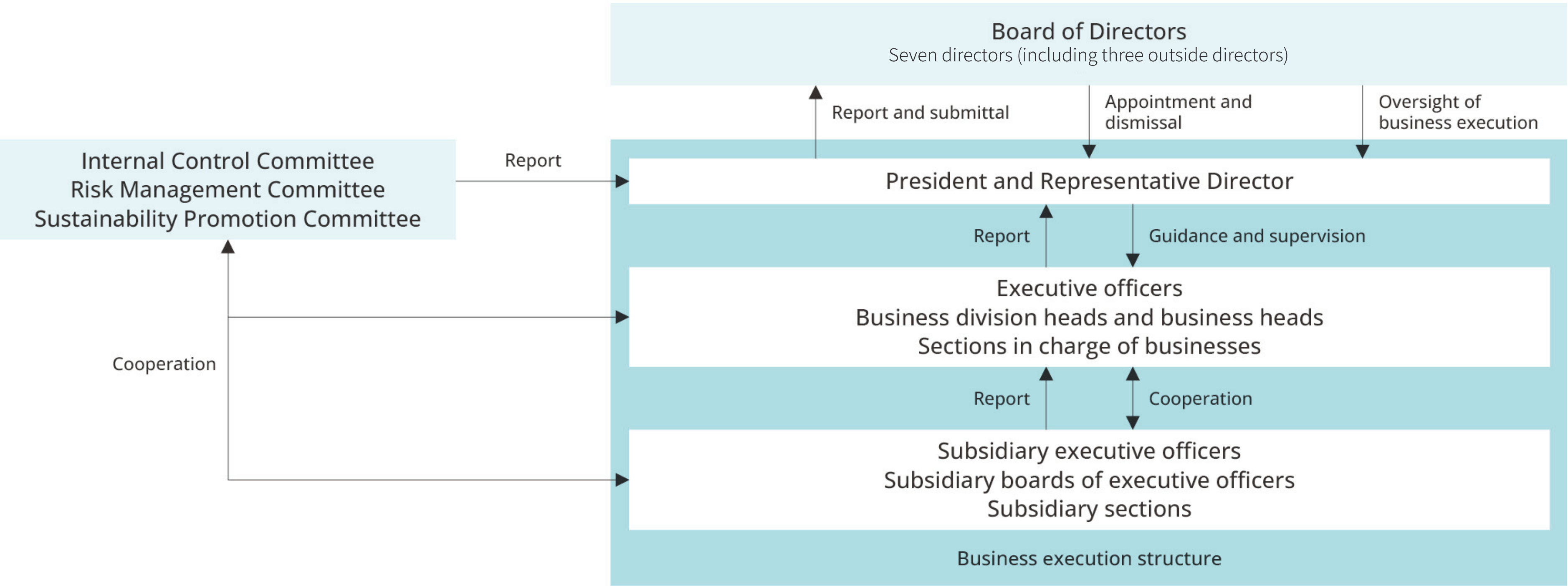
To contribute to the sustainable development of society and enhance
medium- to long-term corporate value, the Group has established a
Sustainability Promotion Committee, chaired by the Director in Charge
of the Corporate Planning Department.
The Sustainability Promotion
Committee convenes semiannually to discuss sustainability-related
management issues, formulate initiatives, set targets, and monitor
progress. The matters discussed and outcomes of the committee are
reported to the Representative Director on an ongoing basis, and progress
is overseen by the Board of Directors, which deliberates on the issues
and provides guidance and instructions as necessary.
Sustainability promotion structure
Risk Management Structure and Process
The Sustainability Promotion Committee identifies important risks related to sustainability by comprehensively assessing and considering overall risk prioritization based on two perspectives: degree of impact on management and likelihood of occurrence. Taking into consideration the corporate and social importance of the identified risks and opportunities, the committee assesses and examines prioritization. Following reports to and deliberations by the Board of Directors, material issues are established. The Board monitors the current progress of and revises measures for the established material issues and conducts appropriate risk management, thereby maintaining and improving a Companywide risk management structure. In addition, the Risk Management Committee, which meets semiannually, works in cooperation with the Sustainability Promotion Committee to cons ider measures for the prevention and mitigation of risks with potentially significant impacts. Important sustainability-related risks are identified and assessed by the Sustainability Promotion Committee.
Scope and significance of risk
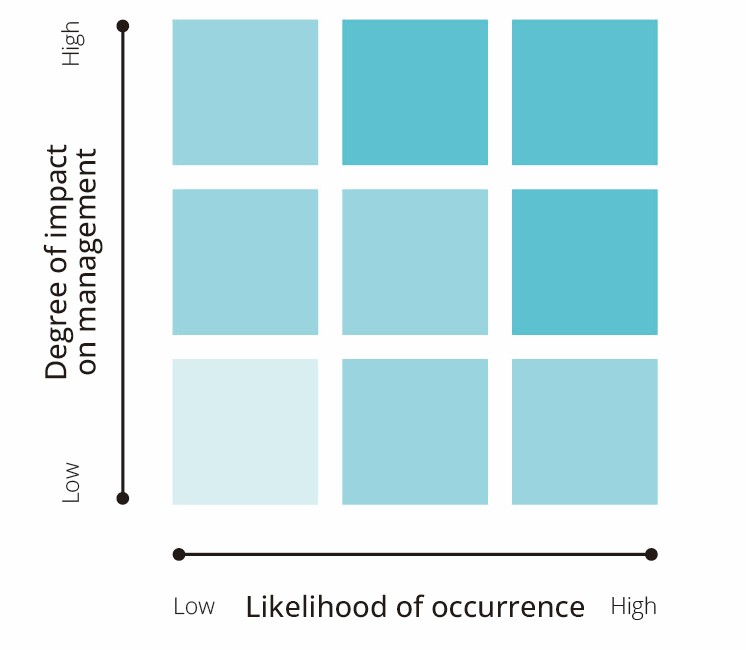
Risks that must be addressed are identified by using the two axes of “degree of impact on management” and “likelihood of occurrence” to assess matters that could become risks due to changes in the internal and external business environment.