Corporate Governance
- Text Size
-
- Small
- Medium
- Large

- Home
- IR
- Management Policy and Growth Strategy
- Corporate Governance
Basic Concept
The S-Pool Group's basic concept on business activities calls for fulfilling our mission, defined as the contributions the Group must make to society. To realize this mission, the Group has a basic policy of corporate governance emphasizing the need to improve management efficiency and transparency. The Group pursues ethical corporate behavior to increase society's trust not just in the Group itself, but in the broader industry. It does so through thoroughgoing compliance with laws and regulations and by developing and enhancing internal control systems. To realize our mission, we have set out more specific visions in the Medium-term Management Plan and also established the S-Pool Values, a shared code of conduct for employees.
Mission
The Group's mission is articulated as follows: Applying the power of outsourcing to support corporate innovation and solutions to society's challenges. In line with this mission, we seek to realize, through our business activities, solutions to various social issues and the associated corporate issues. By pursuing our social businesses, we seek both to create new social value and to play an essential role in society.
Reasons for Not Implementing the Principles of the Corporate Governance Code
[Principle 2-4 ①: Securing Diversity in Appointment
of Core Human Resources, etc.]
Recognizing that the active participation of diverse talent
is essential to achieve sustainable enhancement of corporate
value, the Group conducts fair hiring and promotion focused
on individual abilities and aptitudes, regardless of gender,
age, nationality, job history, etc. We eliminate discrimination
on the grounds of race, nationality, gender, sexual orientation,
etc. and are advancing the development of an environment in
which diverse employees can maximize their abilities. As
specific initiatives to secure diversity, with regard to
the promotion of women to managerial positions, we have
set measurable targets for the ratio of women workers in
managerial positions. We disclose the progress status in
our securities reports.With respect to mid-career hires,
we have been proactively recruiting mid-career professionals
in line with our business expansion, and the percentage of
mid-career hires among our employees is at a commensurate
level. With regard to the promotion of mid-career hires to
managerial positions, we have set no specific numerical
targets at this point in time, but we will promote appropriate
appointments to managerial positions based on ability and track
record, irrespective of job history.Regarding the promotion of
non-Japanese workers to managerial positions, we have set no
specific numerical targets, as the number of eligible individuals
is currently limited. However, we will consider setting such
targets as necessary, taking into account future business
development and changes in our workforce composition.In addition,
as part of our human resource development policies and efforts
aimed at securing diversity, we provide e-learning programs and
other training designed to enhance literacy, thereby promoting
understanding across the organization.Further, to enable diverse
talent to continue to perform and contribute, we are working to
enhance the workplace environment and further develop internal
systems. These policies and the implementation status are disclosed
on our website and elsewhere.
[Principle 4-1 ③: Succession Plan for Chief
Executive Officer (CEO)]
At this point in time, the Company has not established a clear succession
plan for the Chief Executive Officer. We expect to select a successor
drawn from internal and external candidates deemed appropriate in light
of personal characteristics, expertise, track record and other considerations.
As with the succession plan, we have not yet established a system for
guiding the succession process.
[Supplementary Principle 4-10 ①: Optional Nomination
and Remuneration Committees]
The Company's organization is that of a company with a board
of statutory auditors (kansayaku). Independent External Directors
do not constitute a majority of the Board of Directors. No
independent advisory boards such as optional nomination and
remuneration committees have been established to enhance the
independence, objectivity and accountability of the functions
of the Board of Directors in aspects such as the nomination of
candidate Directors and remuneration of Directors.
This is because the current Board of Directors is deemed sufficiently
independent, objective and accountable. Three of the seven Directors
are External Directors, while all three Statutory Auditors are
External Statutory Auditors. External officers account for a majority
of the attendees at meetings of the Board of Directors. Lively debate
takes place in deliberations of matters such as nomination and
remuneration.
Each period, in addition to the nomination of candidate Directors,
individual remuneration for Executive Directors is discussed with
External Directors and Statutory Auditors and their approval
obtained.
[Principle 4-11: Preconditions for Board of Directors and
Board of Statutory Auditors Effectiveness]
The Company Board of Directors features a diverse membership
of Directors with different areas of expertise, experience and
other backgrounds and in terms such as their gender, job history,
and age to ensure that the Board of Directors effectively
fulfills its roles and responsibilities. In accordance with
the articles of incorporation, appropriate numbers of members
are maintained to enable the Board of Directors to exercise
its functions most effectively and efficiently from the following
perspectives:
i) Securing adequate diversity for management decision-making
and oversight
ii) Stimulating debate within the Board of Directors,
centered on the Independent External Directors
To apply the wealth of external experience and expertise in Company
management, enhance the oversight functions of the Board of Directors
and increase management transparency, at least one third of the
Directors are Independent External Directors. The Company has one
Independent External Director who is a woman and one woman Statutory
Auditor.
In addition, while the Company has not appointed External Statutory
Auditors with expert knowledge of financial and accounting topics,
we believe the financial and accounting information needed by the
Board of Statutory Auditors to fulfill its roles can be obtained
through cooperation with External Statutory Auditors and External
Directors who are certified public accountants.
Each fiscal year, to assess the overall efficacy of the Board of
Directors, we undertake anonymous surveys on topics such as the
composition of the Board of Directors, the way in which it operates,
the nature and quality of deliberations by the Board, the monitoring
functionality of the Board and the performance of External Directors.
The results are duly analyzed and evaluated.
To ensure this survey reflects the frank opinions of respondents
and to ensure that such opinions are analyzed and evaluated objectively,
the results are gathered and compiled by an independent institution.
We will continue to assess the efficiency of the Board of Directors
as a whole and to use the results thereof to improve the operations
of the Board.
 Report on Corporate Governance (February 27,
2026)
(PDF_910KB)
Report on Corporate Governance (February 27,
2026)
(PDF_910KB)
- ▼Corporate Governance Structure
- ▼Matters Related to Internal Control Systems, etc.
- ▼Dialogue with Shareholders and Investors
- ▼Cross-Shareholdings
- ▼Special Resolution Requirements of the Shareholders’ Meeting
- ▼Compliance
Corporate Governance Structure
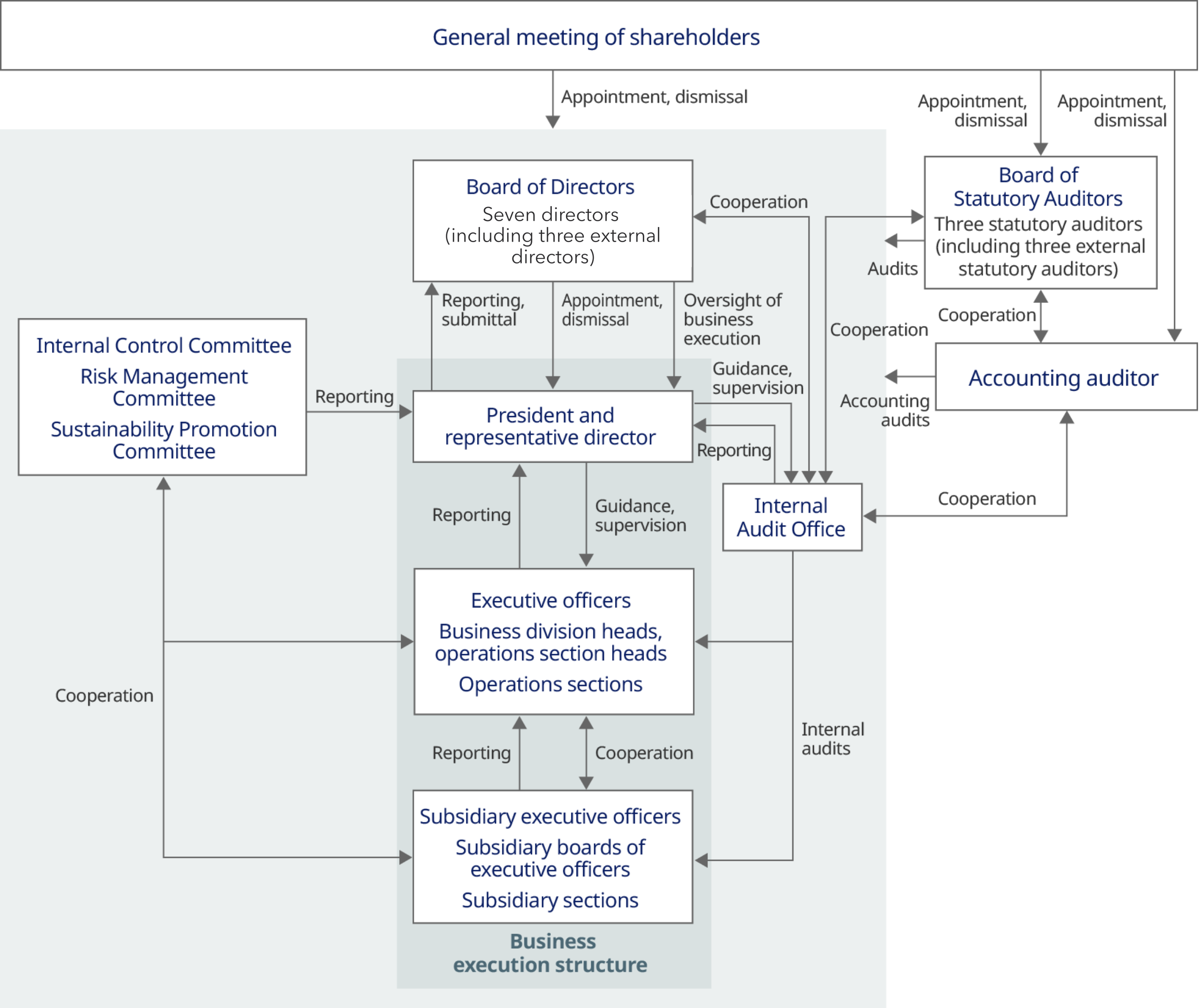
Officers and Business Execution Structure
As management bodies, the Company has established a Board of Directors centered on External Directors and has adopted a system of Statutory Auditors (kansayaku) that it considers capable of demonstrating effective management oversight functions in light of the Company's size.
The Company Board of Directors consists of seven Directors. Its roles include making decisions on Group management policies, management strategies, business plans, acquisition and disposal of important properties, and important organizational and personnel matters, and overseeing the business execution of the Company and subsidiaries. The Board of Statutory Auditors consists of three Statutory Auditors, whose roles are to establish audit policies and plans through deliberations of the Board of Statutory Auditors and to audit the execution of the duties of Directors through attendance in regular and extraordinary meetings of the Board of Directors and in other internal meetings as necessary, as well as auditing the state of business and property at the head office, other business facilities, and subsidiaries. In addition, all external officers have been reported to the Tokyo Stock Exchange as independent officers, and efforts are being made to strengthen governance through operation of a Board of Directors and a Board of Statutory Auditors in which independent officers play a central role.
At the Company, Executive Directors, executive officers, division heads and operations section heads execute business based on business plans formulated by the Board of Directors. The Board of Directors meets monthly, in principle, as well as meeting as needed, to carry out management decision-making and oversight and management of business execution by Directors through review of reports of business results. In addition, to enhance the functions of the Board of Directors and improve management efficiency, the President and Representative Director holds a monthly Group Management Conference with members including Executive Directors, business division heads, and subsidiary presidents, to share management information and to efficiently deliberate on matters related to business execution.
Accounting Auditor
Through comprehensive consideration of matters such as the
availability of a structure capable of centralized audits
of Group business activities, in addition to perspectives
such as the presence of a quality control system,
independence and expertise and continuity and efficiency
of auditing, the Company has chosen Grant Thornton Taiyo
LLC as an auditing firm, to which it entrusts account
auditing operations. It has employed this auditing firm
for 18 years.
The names of certified public accountants employed in
account audits for the period ended November 2025 and the
composition of assistants involved in auditing, are shown
below.
Certified public accountants employed in account auditing:
Designated limited liability employee / business execution
employee Yoichi Honma, Hiroyuki Imai
Composition of assistants involved in audits: 11 certified
public accountants and 16 other assistants.
Independence of External Directors
None of the External Directors or External Statutory
Auditors has a background with a parent company or other
affiliate or is a major shareholder in the Company. In
addition, none of the External Directors or External
Statutory Auditors is a spouse, relative within three
degrees of consanguinity, or equivalent party of an
executive director, executive officer, etc. of the Company
or specific affiliated business of the Company. None
receives executive compensation or other financial gains
from Company subsidiaries. Accordingly, both External
Directors and External Statutory Auditors are deemed
sufficiently independent from the Company.
While the Company has not established specific standards
or policies concerning independence in its appointment of
External Directors and External Statutory Auditors, their
appointment is based on individual judgment of matters
such as their freedom from specific interests in the
Company, such as personal or capital ties, and their
ability to oversee Group management based on a high degree
of knowledge, with reference to the standards for
independence established by the Tokyo Stock Exchange.
Reasons for Appointment of External Directors and External Statutory Auditors
External Director (independent officer)
Toru Akaura
Mr. Akaura is a General Partner of Incubate Capital
Partners, an operating partner of the investment
partnership Incubate Capital Partners, which formerly
was a major shareholder in the Company.
<Attendance at Board of Directors Meetings in
FY2025>
14 / 14(100%)
His appointment is intended to help strengthen and enhance corporate governance through securing further improvements in the efficiency and transparency of Company management.
While he has served as an officer of other companies in the past and currently serves concurrently as an officer of other companies, we have no particular mutual interest nor conflicts of interest with such companies.
There is also no particular mutual interest nor conflicts of interest between Mr. Akaura and the Group, and his appointment is thought to present no particular problems with regard to the independence of External Directors from the standpoint of protection of general shareholders.
Director Akaura has been appointed by the Board of Directors as an independent officer. This is based on the judgment that he is suitable in light of the purposes of independent officers, based on his independence and expertise concerning corporate investment, as described above.
External Director (independent officer)
Nao Miyazawa
<Attendance at Board of Directors Meetings in
FY2025>
14 / 14(100%)
Her appointment is intended to help strengthen and enhance corporate governance through securing further improvements in the efficiency and transparency of Company management.
There is also no particular mutual interest nor conflicts of interest between Ms. Miyazawa and the Group, and her appointment is thought to present no particular problems with regard to the independence of External Directors from the standpoint of protection of general shareholders.
Director Miyazawa has been appointed by the Board of Directors as an independent officer. This is based on the judgment that she is suitable in light of the purposes of independent officers, based on her independence and high degree of legal knowledge as an attorney, as described above.
External Director (independent officer)
Kazuhiko Nakai
<Attendance at Board of Directors Meetings in
FY2025>
14 / 14(100%)
His appointment is intended to help strengthen and enhance corporate governance through securing further improvements in the efficiency and transparency of Company management.
There is also no particular mutual interest nor conflicts of interest between Mr. Nakai and the Group, and his appointment is thought to present no particular problems with regard to the independence of External Directors from the standpoint of protection of general shareholders.
Director Nakai has been appointed by the Board of Directors as an independent officer. This is based on the judgment that he is suitable in light of the purposes of independent officers, based on his independence and high degree of knowledge concerning finance and accounting as a certified public accountant, as described above.
External Statutory Auditor (independent officer)
Xu Jin
<Attendance at Board of Directors Meetings in
FY2025>
Board of Directors: 14 / 14(100%)
Board of Statutory Auditors: 14 / 14(100%)
While she has served as an officer of other companies in the past and currently serves concurrently as an officer of other companies, we have no mutual interest nor conflicts of interest with such companies.
There is also no particular mutual interest nor conflicts of interest between Ms. Xu and the Group, and her appointment is thought to present no particular problems with regard to the independence of External Statutory Auditors from the standpoint of protection of general shareholders.
Statutory Auditor Xu has been appointed by the Board of Directors as an independent officer. This is based on the judgment that she is suitable in light of the purposes of independent officers, based on her independence and efforts to strengthen Group governance as Standing Statutory Auditor, as described above.
External Statutory Auditor (independent officer)
Hiroshi Hatanaka
<Attendance at Board of Directors Meetings in
FY2025>
Board of Directors: 14 / 14(100%)
Board of Statutory Auditors: 14 / 14(100%)
While he currently serves concurrently as an officer of other companies, we have no particular mutual interest nor conflicts of interest with such companies.
There is also no particular mutual interest nor conflicts of interest between Mr. Hatanaka and the Group, and his appointment is thought to present no particular problems with regard to the independence of External Statutory Auditors from the standpoint of protection of general shareholders.
Statutory Auditor Hatanaka has been appointed by the Board of Directors as an independent officer. This is based on the judgment that he is suitable in light of the purposes of independent officers, based on his independence and expertise in management in general as a management consultant and manager with other companies, as described above.
External Statutory Auditor (independent officer)
Noboru Yamashita
<Attendance at Board of Directors Meetings in
FY2025>
Board of Directors: 14 / 14(100%)
Board of Statutory Auditors: 14 / 14(100%)
While he has not been involved in corporate management other than having served in the past as an external director and external auditor, it was judged that he possesses extensive specialized knowledge related to labor as a labor and social security attorney and that he would be able to utilize this knowledge in auditing at the Company.
There are no particular mutual interests or conflicts of interests between Mr. Yamashita and the Group and no particular problems with regard to his independence as an External Auditor from the standpoint of protecting general shareholders.
Statutory Auditor Yamashita has been appointed by the Company as an independent officer on the Board of Directors.
As stated as above, this is because he is independent, possesses extensive knowledge related to personnel and labor as a labor and social security attorney, and so has been judged to be suitable in light of the purposes of independent officers.
Skills Matrix
| Specialization and experience | ||||||||
|---|---|---|---|---|---|---|---|---|
| Gender | Corporate management |
Business development, M&A |
Finance, accounting | CSV ESG | HR development | Compliance, risk management | ||
| Directors |
Sohei Urakami Chairman of the Board and Representative Director |
Male | ○ | ○ | ○ | |||
|
Giichi Shirakawa President and Representative Director |
Male | ○ | ○ | ○ | ○ | ○ | ||
|
Hideaki Sato Director |
Male | ○ | ○ | ○ | ||||
|
Naoshi Arai Director |
Male | ○ | ○ | ○ | ||||
|
Toru Akaura External Director |
Male | ○ | ○ | |||||
|
Nao Miyazawa External Director |
Female | ○ | ||||||
|
Kazuhiko Nakai External Director |
Male | ○ | ||||||
| Statutory Auditor |
Xu Jin Standing Statutory Auditor |
Female | ○ | ○ | ||||
|
Hiroshi Hatanaka External Statutory Auditors |
Male | ○ | ○ | ○ | ||||
|
Noboru Yamashita External Statutory Auditors |
Male | ○ | ○ | |||||
* This table does not show all skills possessed by each director and statutory auditor.
Definition of Skills
The experience, knowledge, expertise, and other qualities that members of the Company’s Board of Directors should possess as well as the reasons selecting these attributes are shown below.| Details and Reasons for Selection | |
|---|---|
| Corporate Management | Management-related insight, knowledge, and implementation skills that have been cultivated through business management experience are important for formulating medium- to long-term growth strategies in an ever-changing business environment. |
| Business Development and M&A | Skills in business development and mergers and acquisitions (M&A) are important for maximizing corporate value through such activities as the selection and execution of investments that align with the Company’s strategy, expansion into new business fields, and reorganization of business portfolios and are important for supervising the progress of these activities. |
| Finance and Accounting | Experience and specialized knowledge acquired as a chief financial officer or certified public accountant are important for business management that is aimed at building a sound financial foundation, pursuing capital efficiency, and realizing growth strategies. |
| CSV and ESG | Our business activities themselves are fundamental to sustainability. Possession of the knowledge and specializations that are needed to assess value in relation to environmental, social, and governance (ESG) factors and the social significance and sustainability of the Company are important for advancing business management that is focused on creating shared value (CSV). |
| Human Resource Development | Development In creating even better services, human resources are the most important factor, and they represent the Company’s most important form of capital. Knowledge, experience, and expertise in relation to human resource strategies are important for the maximization of human capital with the aim of sustaining growth. |
| Compliance and Risk Management | Knowledge and experience in relation to risk management and legal affairs are important for establishing appropriate governance capabilities, anticipating important risks associated with business operations, promoting sound business activities, and ensuring compliance with laws and regulations |
Remuneration of Directors and Statutory Auditors
| Annual total remuneration of Directors | 96 million yen (including remuneration of External Directors of 10 million yen) |
|---|---|
| Annual total remuneration of Statutory Auditors | 19 million yen (including total remuneration for External Statutory Auditors of 19 million yen) |
The maximum limit on annual remuneration for Directors
under a resolution of the February 27, 2018 general
meeting of shareholders is 200 million yen (including up
to 30 million yen per year for the remuneration of
External Directors). Remuneration amounts are determined
in consideration of the posts and duties of each Director
within this maximum limit.
Remuneration of Executive Directors consists of fixed
remuneration and performance-linked bonuses. In addition,
the work-linked bonus for representative directors
incorporates social and environmental items as
non-financial indicators and is linked to short- and
long-term compensation programs. Amounts of which are
calculated through methods specified in internal rules. In
consideration of the nature of their posts, remuneration
for non-executive Directors and Statutory Auditors, whose
positions are independent from business execution, is paid
in the form of fixed remuneration only.
Amounts of fixed remuneration for Executive Directors are
proposed for each individual by the Representative
Director in a regular meeting of the Board of Directors
held after the annual settlement of accounts has been
finalized, reflecting matters such as the duties,
abilities, experience, and years of service of each
Director in addition to his or her performance in the
previous period, including increases or decreases in
corporate value, measures implemented regarding returns to
shareholders, growth in sales and profit, development of
new businesses, and progress of human resource development
and organizational development. Final decisions are made
through deliberation on the proposed remuneration amounts
among parties including non-executive Directors and
Statutory Auditors.
Matters Related to Internal Control Systems, etc.
Considering the main purposes of internal controls to be maintaining legal and regulatory compliance, improving business efficiency, and ensuring the reliability of financial reports, the Company strives to establish effective internal control systems through appropriate planning, development, operation, monitoring, and audits.
1. Overview of the state of operation during this business year
Compliance initiatives
The Company President and Representative Director issues periodic messages on the importance of compliance to Company and subsidiary Directors and employees. Internal training is provided on information security, prevention of insider trading, and other topics, as part of continuous efforts to raise awareness on compliance.
Risk management initiatives
The Board of Directors ascertains and evaluates risks
Groupwide and considers responses to risks with impacts
across the organization. In addition, monthly Group
Management Conferences in which the External Directors and
Standing Statutory Auditor take part include information
sharing and deliberation on the state of management of
risks accompanying the businesses of individual sections
and subsidiaries.
During the fiscal period ended November 2025, the Board of
Directors and Group Management Conferences played central
roles in managing the risk generation status and the
status of implementing preventive measures for risks the
Company has consistently deemed of utmost importance:
those involving legal amendments or strengthened
regulations with the potential to impact the business
environment; labor issues, such as industrial accidents
and long working hours, leakage of personal information
and industry-specific issues that may impact management
strategies, such as changes in economic or market
conditions, as well as the potential impact of events
involving competitors, including mergers and acquisitions
or decisions to open competing facilities.
In addition, the Group is working actively to strengthen
productivity through IT investments and other initiatives.
We have raised the importance score of the risk of failing
to achieve the purpose of introducing IT systems due to
inadequate prior consideration regarding their
introduction and are carefully ascertaining current
conditions and managing progress.
Efforts to ensure the propriety and efficiency of the performance of duties of Directors
The Company Board of Directors consists of seven Directors,
including three External Directors. The three External
Statutory Auditors also attend Board meetings. During the
fiscal period ended November 2025, the Board of Directors
met 14 times and implemented timely decision-making while
paying close attention to lawful and appropriate
operations. Matters related to risk management and
business execution were deliberated on, in addition to
confirmation and analysis of and development of
appropriate strategies for the state of progress in
businesses and performance of each section and subsidiary.
The Board of Directors also monitored the state of
performance of the duties of Directors of the Company and
subsidiaries.
Materials for deliberation by the Board of Directors are
distributed in advance to enable attendees to prepare
adequately. Directors and Statutory Auditors actively
exchange opinions at the deliberations.
Matters involving important management decision-making at
subsidiaries are resolved at the Company’s Board of
Directors meetings.
Systems for reporting by Directors and employees to Statutory Auditors, and other systems related to reporting to Statutory Auditors
An internal whistleblowing system (compliance hotline) has been established as a reporting system for the entire Group, with non-standing External Statutory Auditors serving as contact points. In addition, efforts are being made to raise awareness among all Group employees through the Group intranet.
Performance of the duties of Statutory Auditors
Based on audit plans, the Standing Statutory Auditor attends Group Management Conferences and important meetings of subsidiaries to confirm appropriate business execution and shares information in meetings of the Board of Statutory Auditors, which met 14s times during the fiscal period ended November 2025. In addition, business auditing is conducted in cooperation with the Internal Audit Office, ascertaining information on a wide range of risks through interviews with officers and employees. Meetings also are held with the accounting auditor, both periodically and at other times as needed, to ascertain the propriety of financial accounting.
2. Basic concept on exclusion of antisocial forces and state of these efforts
Basic concept on exclusion of antisocial forces
The Company's basic policy is to refuse any and all relations to antisocial forces and to respond resolutely, as an organization, to any improper demands or inducements.
State of efforts to exclude antisocial forces
The Company's General Affairs Department is tasked with coordinating response to antisocial forces. Since December 2003, we have been a member of Tokubouren, an association under the Metropolitan Police Department that seeks to prevent specified acts of violence. In addition to striving to collect information through attending its regular meetings and other events, we seek its guidance as needed.
Dialogue with Shareholders and Investors
1. State of initiatives to stimulate participation in the general meeting of shareholders and facilitate the exercise of voting rights
Early dispatch of convocation notices for the General Meeting of Shareholders
In principle, while ensuring the accuracy of the information
contained in the convocation notice, we dispatch the notice
at least one day prior to the statutory deadline in order to
secure sufficient time for shareholders to consider the agenda
items for the General Meeting of Shareholders.
In addition, prior to the dispatch of the notice, the information
is disclosed on our website and on the Tokyo Stock Exchange
website to ensure that shareholders have adequate time to review
the agenda items.
Scheduling general meetings of shareholders to avoid dates when there are large numbers of such meetings held
We avoid holding general meetings of shareholders on dates on which large numbers of such meetings are held by ending our fiscal period on November 30. We intend to continue to focus on stimulating participation in general meetings of shareholders. We hold briefings on topics such as the Company's lines of business and future strategies after the general meetings of shareholders to expand shareholder participation.
Exercise of voting rights through electromagnetic means
We have adopted exercise of voting rights through an electromagnetic method.
Participation in a platform for electronic exercise of voting rights and other initiatives to facilitate exercise of voting rights by institutional investors
We participate in a platform for electronic exercise of voting rights operated by ICJ, Inc.
Availability of English translation of notices of general meetings of shareholders (abstract)
We post the English translation of notices of general meetings of shareholders on our website.
2. State of IR activities
Holding periodic briefings for individual investors
Briefings for individual investors are held several times a year across Japan. In addition, materials are posted on our IR website at a later date so that those who find it difficult to attend can access the content.
Holding periodic briefings for analysts and institutional investors
Upon the settlement of accounts each fiscal year, the Company holds a briefing on its financial results and business strategies. A similar briefing is also held in the second quarter.
Posting IR materials on the website
IR information is disclosed at www.spool.co.jp/investor/. Information on the settlement of accounts and timely disclosure materials, briefing materials, and FAQs are made available.
Establishing an IR section (person in charge)
The Corporate Planning Department is in charge of IR.
Cross-Shareholdings
The Company does not hold any cross-shareholdings.
Special Resolution Requirements of the Shareholders’ Meeting
Amendments to the Articles of Incorporation and other important matters specified in Article 309, Paragraph 2 of the Companies Act require approval by a special resolution at a General Meeting of Shareholders. The Company’s Articles of Incorporation stipulate that a special resolution shall be adopted by at least two-thirds of the voting rights represented at a meeting attended by shareholders holding at least one-third of the voting rights exercisable at the meeting. This provision is intended to facilitate the smooth operation of General Meetings of Shareholders by relaxing the quorum requirement for special resolutions.